When Oil Stops Flowing: What the Closure of the Strait of Hormuz Means for Koh Samui’s Property Market in 2026?

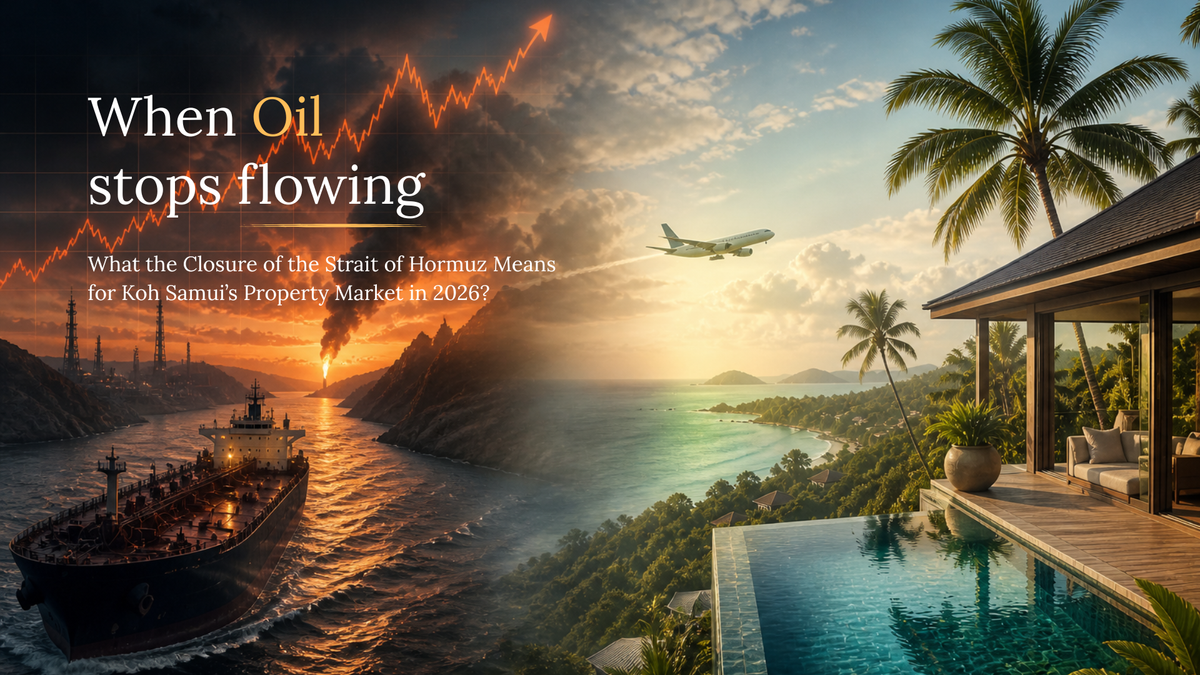
The closure of the Strait of Hormuz is no longer a theoretical risk—it is a reality, and its effects are already moving through the global economy. What happens in a narrow maritime corridor between Iran and Oman is now directly influencing decisions made by travelers, airlines, and property owners thousands of kilometers away in Koh Samui.
This is not the first time global shocks have tested the resilience of island markets. But unlike previous crises, this one is not about demand disappearing (at least not completely)—it is about demand reshaping itself under pressure. (whilst definitely decreasing)
At the center of it all is energy. With a significant portion of the world’s oil supply disrupted, fuel prices have surged. Airlines are among the first to feel the impact, and as ticket prices climb, long-haul travel becomes more expensive and, for many, less accessible. European and American travelers—traditionally key markets for Koh Samui—are now reconsidering how far they travel, how long they stay, and how much they spend.
In the early phase of this disruption, which we are now seeing in Q2 2026, the effects are subtle but noticeable. Many bookings were made months in advance, so occupancy levels have not (yet) collapsed. However, behavior is shifting. Guests are booking later, comparing more options, and becoming increasingly price-sensitive. The confidence that once drove premium pricing is beginning to soften.
As we move deeper into Q3, the impact becomes more structural. Higher airfares start to meaningfully reduce long-haul arrivals. This does not mean Koh Samui becomes empty—it means the composition of its visitors changes. Regional travelers from Asia and Australia become more prominent, while Western markets slow. Stays tend to shorten, and guests are more deliberate in how they allocate their budgets. For property owners, this translates into stable occupancy in many cases, but increasing pressure on nightly rates.
By Q4, the market begins to adapt. Travelers adjust to the new cost environment, and demand returns for the high season—but it returns differently. Price sensitivity remains, competition between villas intensifies, and the gap between well-managed properties and the rest becomes much more visible. Properties that are correctly priced, professionally marketed, and aligned with current demand patterns continue to perform. Others struggle to maintain both occupancy and rates.

Interestingly, while the holiday rental market faces adjustment, the long-term rental segment is moving in the opposite direction. Periods of global uncertainty tend to push people toward stability, and Koh Samui is increasingly seen as a place where that stability can be found. Remote workers, retirees, and long-stay visitors are less affected by short-term fluctuations in flight prices. Some travelers who might have stayed for a week or two are now choosing to stay for months, seeking better value and a more predictable cost of living. This creates a quiet but important shift: villas that may underperform in the short-term market can find new strength when positioned for mid- to long-term tenants.
For property owners, this is where the conversation becomes more strategic. The focus naturally shifts away from maximizing peak returns toward ensuring consistent income across the year. Flexibility becomes more valuable than rigidity. A villa that can move between short-term guests, monthly stays, and longer leases is better positioned to navigate uncertainty than one locked into a single model.

At the same time, operating costs are rising. Energy, transportation, and staffing are all affected by the same global forces driving fuel prices upward. This makes efficiency not just a preference, but a necessity. Margins are protected not only through revenue strategies, but through disciplined cost management and smarter operations.
What we are witnessing is not a collapse of the Koh Samui market, but a recalibration. The island remains highly attractive—perhaps even more so in a world where travelers are increasingly selective about where they spend their time and money. Compared to Western destinations, Koh Samui still offers strong relative value, a high quality of life, and a unique lifestyle proposition that continues to draw people in.
However, the margin for error is shrinking. Pricing too high, reacting too slowly, or relying on outdated assumptions about demand can quickly lead to underperformance. In contrast, properties that adapt—those that understand shifting guest behavior, adjust their positioning, and embrace professional management—are not only weathering the situation, but in many cases outperforming the market.
The closure of the Strait of Hormuz is a powerful reminder of how interconnected the world has become. For Koh Samui’s property sector, it marks the beginning of a new phase—one defined not by decline, but by adaptation. The opportunities remain very real, but they increasingly belong to those who move early and think strategically.