
Thailand’s Property Crackdown: Compliance Requires Clarity and Accountability Must Be Shared

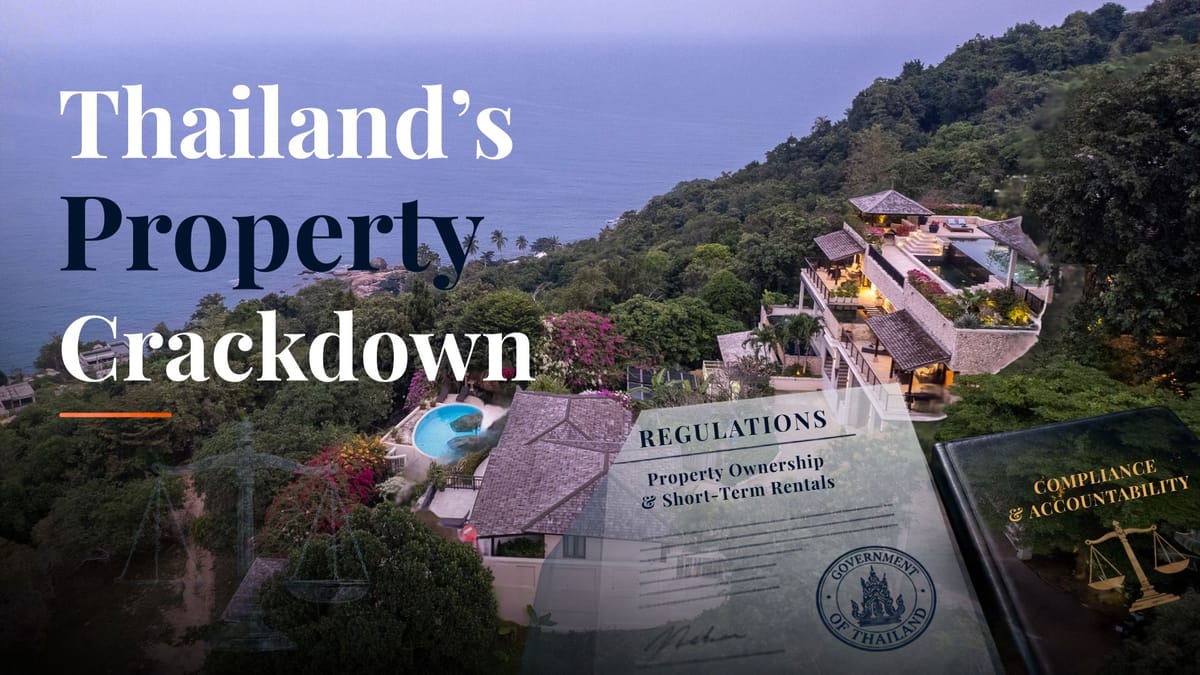
As Thailand strengthens enforcement around foreign property ownership and short-term rentals, the discussion should not be about whether the law should be respected. It should be about how an entire industry moves toward compliance fairly, transparently and responsibly.
Recent enforcement actions concerning foreign property ownership, nominee structures and short-term rentals have understandably created considerable uncertainty across Thailand’s real-estate and hospitality sectors.
Koh Samui is no exception.
Foreign property owners are reviewing ownership structures. Villa operators are questioning licensing requirements. Property-management companies are reassessing their operating models. Lawyers and accountants are being asked for clarification, sometimes on structures they themselves helped establish years ago.

At Siam-CS Management, our position is straightforward:
Thai law must be respected, and businesses operating in Thailand must work toward full compliance.
But achieving that objective requires something equally important:
Clear regulations, consistent interpretation, professional accountability and a realistic pathway for existing businesses and property owners to regularise their situations.
A Question Worth Asking
A recent opinion article published by The Thaiger, written from a Thai perspective, raised an important question regarding the current investigations into foreign property ownership:
If a questionable ownership structure involved foreign buyers, Thai shareholders, developers, accountants, lawyers and official registration processes, why should accountability stop with the foreign investor?
It is an uncomfortable question — but a legitimate one.
It does not mean that foreign investors should be exempt from Thai law.
They should not.
It means that compliance and accountability cannot reasonably be examined only at the end of the chain.
For many years, foreign investors arriving in Thailand have relied on Thai professional advisers precisely because they do not possess the expertise required to navigate Thai corporate, property, tax and licensing legislation.
They hire lawyers.
They hire accountants.
They hire corporate advisers.
They purchase properties from established developers.
Companies are incorporated, accounts are prepared, taxes are submitted and transactions are registered.
When structures that were established and maintained through this professional ecosystem are subsequently challenged, it is reasonable to examine the entire chain of advice and responsibility.

“This Is How Everyone Does It” Is Not Legal Advice
This is perhaps one of the most important lessons emerging from the current situation.
There is an enormous difference between:
“This is commonly done in Thailand.”
and:
“This structure fully complies with Thai law.”
Over many years, certain practices became commonplace across Thailand's property industry.
But widespread practice does not automatically create legal compliance.
Professional advisers have an important responsibility here.
When a foreign investor pays a lawyer, accountant or corporate adviser for professional advice, that client should reasonably expect to be informed not only about how a structure can be established, but also about:
- its legal basis;
- its limitations;
- the licences required;
- the tax implications;
- potential regulatory risks;
- alternative compliant structures; and
- what could happen if authorities subsequently enforce regulations differently or more strictly.
The objective of professional advice should not simply be to make a transaction or business model possible.
It should be to make the client understand whether it is compliant — and where it may not be.
The Same Question Now Exists for Short-Term Rentals
This discussion is particularly relevant to the villa rental industry.
For years, thousands of villas throughout Thailand have been offered to tourists through Airbnb, Booking.com and other international platforms.
An entire economic ecosystem has developed around this activity.
Property owners employ management companies.
Management companies employ property managers, housekeepers, maintenance technicians, gardeners, pool technicians, reservation teams, accountants and administrative staff.
Guests use taxis, restaurants, supermarkets, massage shops, beach clubs, excursion companies and countless other local businesses.
The economic activity is real, visible and significant.
Yet today, many owners and operators are discovering that the regulatory environment surrounding short-term villa rentals is considerably more complicated than they previously understood.
Questions concerning hotel licences, exemptions, rental periods, company structures, foreign ownership, VAT, taxation and operating licences are suddenly receiving much greater attention.
And once again, the same question must be asked:
What professional advice was provided to property owners when these activities were originally established?
Many foreign owners did not independently decide how to structure their investment, taxation or rental operation.
They sought professional advice.
They asked whether they could rent their property.
They asked whether they could advertise on Airbnb.
They asked whether they needed a licence.
They asked how rental income should be declared.
They asked whether a company should be established.
And they paid professionals to provide those answers.
This does not remove the responsibility of an owner or operator to comply with Thai law.
But neither should the responsibility of the professional advisers who structured, recommended or maintained these arrangements be ignored.
Enforcement Alone Will Not Solve the Problem
Thailand has every right to regulate its property and tourism industries.
Indeed, professional operators should welcome stronger regulation.
Clear regulations protect legitimate businesses.
They improve guest safety.
They establish minimum operating standards.
They create fairer competition.
They encourage proper taxation.
And they remove operators who deliberately ignore their obligations.
But enforcement is most effective when businesses clearly understand what compliance actually requires.
For the villa rental industry, several fundamental questions require consistent and accessible answers.
What constitutes a legally compliant short-term villa rental?
When is a hotel licence required?
What exemptions exist, and under precisely what conditions?
Is the licence attached to the property, the owner or the operator?
What responsibilities belong to the property owner and what responsibilities belong to the management company?
How should international booking platforms be treated?
How should rental income, management commissions and VAT be accounted for?
What corporate structures are permitted?
And perhaps most importantly:
How should existing owners and operators who genuinely want to comply transition from historical practices into the required framework?
Different answers from different lawyers, accountants, government departments and local authorities create uncertainty rather than compliance.
The Industry Needs a Path to Regularisation
There is an important distinction between someone deliberately attempting to circumvent Thai law and someone who established a business or investment structure in good faith based upon professional advice.
Regulation should recognise that distinction.
Where historical structures need to change, Thailand could create mechanisms allowing owners and businesses to regularise them.
That could include reasonable transition periods, published compliance guidelines, clearly defined licensing procedures and coordinated communication between relevant authorities.
The objective should ultimately be simple:
Bring legitimate economic activity into a transparent, regulated and taxable framework.
Closing businesses, frightening investors or creating uncertainty should not be the objective.
Creating compliance should.

Property Managers Have a Role to Play
Professional property-management companies should also recognise their responsibility.
Our industry cannot simply wait for authorities to provide every answer.
We should participate in building better standards.
Property managers collectively represent a substantial part of Koh Samui's tourism accommodation infrastructure.
We interact every day with owners, tourists, employees, contractors and local businesses.
That gives our industry both an opportunity and an obligation to contribute constructively.
Rather than opposing regulation, professional operators should work with authorities to help define practical standards covering licensing, guest registration, safety, taxation, property operations and consumer protection.
The message from our industry should be:
Tell us clearly what compliant operations require, and we will help implement them.
A More Professional Industry Can Emerge
The current period of uncertainty can ultimately become something positive.
Thailand's villa rental sector has grown enormously over the past decade.
Perhaps regulation simply needs to catch up with the reality of that growth.
Koh Samui now has an opportunity to establish a professional villa-management and rental framework that protects Thailand while continuing to encourage responsible international investment and tourism.
That requires cooperation between:
property owners, property-management companies, lawyers, accountants, developers, tourism authorities, local administrations and national regulators.
Everyone has a role.
And everyone should accept their share of responsibility.
At Siam-CS Management, we believe the future of our industry should be based on professionalism, transparency and compliance.
We support clear regulation.
We support appropriate licensing.
We support proper taxation.
We support stronger professional standards.
But compliance cannot operate effectively in an environment where regulations are unclear, interpretations differ between advisers and authorities, and responsibility is placed exclusively on the person standing at the end of a much larger professional chain.
The Way Forward
Thailand does not need less regulation.
It needs clearer regulation, consistent implementation and shared accountability.
Foreign investors and operators must take responsibility for complying with the laws of the country in which they choose to invest and conduct business.
Professional advisers must take responsibility for the structures and recommendations they provide.
Industry operators must raise their standards.
And authorities can help legitimate businesses transition toward compliance by providing clear, practical and consistent pathways to do so.
The objective should not be to defend yesterday's practices.
It should be to build tomorrow's standards.
For Koh Samui's property and hospitality industry, this may be an important moment of transition.
Handled correctly, it can lead to a stronger, more transparent and more professional industry — one that protects Thailand's interests while continuing to welcome responsible investment and the millions of visitors who contribute to its local economies every year.
Compliance should be the destination.
Clarity and shared accountability are how we get there.
Siam-CS Management
Koh Samui, Thailand